With Cesar In The Amazon Jungle, author Bo Bryan
The first time I went to the Amazon, I was afraid to set foot in the jungle. Mainly I felt the absence of a pistol to carry. I didn’t realize that most of the danger for humans in the Amazon is microscopic, and not a whole lot of that, but enough that a good jungle guide, if you trust one, keeps you feeling more courageous than a pistol.
Then you have the snakes, spiders, man-eating fish, all that to invigorate your imagination. But all you have to do is follow the jungle guide, step here, not there, count your fingers and toes at both ends of the journey.
I met Cesar Peña in the city, in downtown Iquitos, Peru, which like the jungle, looks dangerous due the urban zoo-like atmosphere of a town that is mostly populated with people who are not far removed, only several generations advanced, from the Stone Age.
Cesar was riding a motorcycle, a dirt bike jacked up on the front end. He wore blue jeans and a golf shirt, the uniform of college fraternity boys. His bearing was that of a college student. By that I mean he bore the posture of entitlement. His confidence had authority behind it. He knew something about himself, and the environment he moved in, that would lead a stranger to ask questions.
Yes, It’s Working
I’m so proud to report that AidJoy’s collaboration with Project Amazonas is resulting in thousands of people receiving healthcare in the Amazon.
I’ve been working for over two months in the Amazon. During that time I participated in two consecutive medical expeditions. Aboard the first expedition over 85% of the international volunteers (people living outside Peru) learned about Project Amazonas from AidJoy’s work. On the following expedition 100% of the international volunteers became participants because of AidJoy’s work. What began with a Google search such as “amazon medical trip” resulted in volunteers bringing medical aid to people in the Amazon.
“When I wanted to take an authentic trip to the Amazon I searched online and found Project Amazonas. Everything I read and watched exceeded my expectations. With Project Amazonas I’m more than a traveler, I’m a participant.” Dr. Paul Kater
Technology, Media, and Marketing Volunteers.
Since 2008 there have been over seventy volunteers working at AidJoy to help expand the extraordinary efforts of Project Amazonas. This is the complete list of AidJoy’s wonderful participants: http://www.aidjoy.org/ngo-corporate/index.html.
Together our work enables Project Amazonas to:
* Provide medical aid to thousands of people.
* Purchase and equip an improved primary boat; the 74foot “Nenita”.
* Grow their volunteer base from around the globe.
What Happens Next?
We are going to show the world how difficult it is to receive medical care from remote parts of the Amazon rainforest. Additionally, people will get to meet the medical professionals that are dedicated to helping the people in the Amazon. And lastly, we will introduce a couple of sustainable solutions to the hardships facing these people.
* My deepest appreciation goes to ForeignTranslations.com, WatershedCabins.com and our generous individual donors. Without your support this work would not be possible.
To see photographs of medical clinics cruise over to our Flickr page:
http://www.flickr.com/photos/aidjoy/sets/72157626893034477/
Also, some of Mike’s favorite photos are here:
http://www.flickr.com/photos/aidjoy/sets/72157627017723026/
Huge Hug,
Jonathan
Marilu’s Journey To Medical Care
It’s my pleasure to introduce you to Mayer. Mayer and his wife Marilu have two children. We greatly appreciate Mayer taking time off of work to recount his wife’s third pregnancy with us.
When you travel through this part of the world you will see a lot of buildings with thatched roofs. The best of these roofs will withstand the daily torrential rains for seven years. The expertise to make such a roof is passed from master to apprentice. On the Cochiquinas river, Mayer is that master.
Three years ago Mayer’s wife, Marilu, was pregnant with their third child. She was also struggling with a mild case of malaria. It wasn’t mild in the eyes of Marilu. She was outspoken about the severity of her malaria with Mayer. But she didn’t look that sick, and how many times can someone be taken seriously if they piss and moan about cold after cold. It’s a rainforest here. It’s really humid and bronchial infections are as common as people sneezing when flowers begin to bloom back in South Carolina.
The sole bread earner can hardly be expected to play nursemaid every time his hypochondriac of a wife comes down with a cold.
Mayer goes back into the jungle to continue making thatched roofs.
At the time we first met Mayer he was working to fulfill an order for 100 thatchings. That’s enough material to cover a comfortable family house in the suburbs.
Unfortunately Marilu’s health continued to deteriorate while Mayer was out of town. Her father saw the urgency of the situation and took off to find Mayer.
Getting Marilu the help she needed was now the entire family’s highest priority. The following morning Marilu and Mayer paddled their dugout canoe eight hours to the mouth of the river, seeking help from a shaman. The dire nature of this situation is readily apparent to everyone. Mayer recounts to us his wife’s words, “you’ve killed me Mayer. You left me when I needed help and now you’ve killed me.”
At the point where the Cochiquinas and the Amazon River meet they find a shaman. She takes Mayer aside for further consultation.
Note: We haven’t talked with this shaman yet. I can only tell you what Mayer has shared with us.
“While you were away working another man has fallen in love with your wife. He wished you would die and sought the help of a different shaman. A curse that was intended for you was accidentally placed on your wife. Now I’m unable to help her.”
The nearest help from this point will take over a day of paddling to reach. Despite that tail of jealousy, the people in this area do take care of one another. Victor (I hope to have the actual name of this person for you soon) shuttled Mayer and Marilu down the Amazon to the nearest medical center in the village of San Francisco in his peki-peki.
Marques is the medical technician in San Francisco. Like the shaman, Marques did not feel qualified enough to help Marilu.
With the continued generosity of Victor, the peki-peki’s owner, they continue their journey to Pevas.
Pevas is the main city for over 100 communities. There are 6,000 people in Pevas and the hospital has a staff of thirty.
No different than the shaman and medical technician, the doctors in Pevas were not capable of providing the care that Marilu required. They would need to travel to Iquitos.
The journey from Pevas to Iquitos:
A. Several days via peki-peki (substantial canoes with outboard engines).
B. twenty-four hours via colectivo (large boats transporting everything from people and chickens to bananas).
C. six hours via rapido (we call them speed boats).
Question: How expensive is too expensive to save your wife’s life?
Answer: $192
Facts from the rainforest:
A. Mayer earns 50 cents for each 12 foot length of thatching.
B. Annually Mayer earns roughly $400.
C. That $400 feeds their two kids, parents, and Marilu’s sister.
D. In Pevas a gallon of fuel is over four dollars.
E. A rapido consumes eight gallons of fuel per hour.
F. The trip from Pevas to Iquitos is six hours.
While Marilu is receiving medical care Mayer seeks funds from the mayor of Pevas. For emergency situations, such as this one, the mayor is able to provide funding for fuel.
The following morning Mayer and Marilu are on a rapido headed to Iquitos. Marilu’s harsh words soften on this final leg of their journey, “This situation is not your fault Mayer. You need to take care of our kids. They are all that matter. Take care of our kids.”
Marilu dies en route to Iquitos. Their unborn child is trapped and dies within her.
Mayer continues to make thatched roofs. He is not always alone in the jungle. “My children are now apprenticing with me. They are not ready to make thatching on their own. I am teaching them slowly and carefully.”
Travel Time To Medical Care In The Amazon Rainforest
* 8 hours in a dugout canoe
* 3-4 hours in a peki-peki from the Cochiquinas river to the medical center in the village of San Francisco
* 6 hours in a peki-peki from San Francisco to the hospital in Pevas
* 6 hours in a rapido from Pevas to Iquitos
TOTAL TRAVEL TIME: 23-24 hours to proper medical care
* Without the support of http://www.foreigntranslations.com and generous individual donors this work would not be possible.

Cesar Pena interviewing Mayer Chavez about his wife’s tragic story trying to get to medical care in time.
April In The Amazon With AidJoy
The Forward
As many of you know I really enjoy telling a story, and I spend hours and hours on the phone bringing people up to speed on what is new over at AidJoy. Sitting down and writing on the other hand seams to consistently get trumped by the daily fires that flair up.The stories we have been piecing together over the last few weeks simply cannot get pushed aside for project management or thank you notes.
Intro
Why have we returned to the Amazon?We are here to tell you about how extraordinarily difficult it is to get medical care in remote areas in the Amazon rainforest.
Once we illustrate this truth we will introduce you to a group of individuals that have been working to counteract this medical crisis since 1994.
How can we allow you to see through our eyes?
We are setting out to show you the people and the area they call home in the form of audio recordings, still images, small video cameras we wear as we work, and traditional videography. With all of this story telling equipment you’ll be able to gain an appreciation for the journey one must take when they need emergency medical care.
What has been accomplished in April?
We’ve been interviewing patients and medical staff in medical facilities and their homes within a several hundred-mile radius of Iquitos Peru.Getting access to interview these people has been possible through our relationships with the former minister of health in the Loreto Region of Peru and the NGO Project Amazonas. That trust has been earned over 2.5 years of collaboration.
People’s open doors and hearts
I cannot emphasize to you enough how forthcoming patients and medical staff has been. We start off conversations with a brief introduction of who we are and what we aim to accomplish. From that point people begin to share a story of one of the saddest points in their life. We have seen time and again people do everything in their power to equip us with what we believe can help them in the years to come.
Actions of desperation
* To allow us to photograph their daughter’s bottom that is horrifically burned is an act of desperation.* To tell us about being carried on a hammock for hours while your newborn remains connected to you by an umbilical cord is an act of desperation.
* A father that volunteers to loose a weeks pay, that he can ill afford, to talk with us next week is an act of desperation.
What’s coming?
Over the next week or so I will walk you through several of the stories we have been deeply effected by.In the next blog entry you’ll learn about Marilu’s pregnancy while she had malaria.
* Without the support of http://www.foreigntranslations.com and generous individual donors this work would not be possible.
Huge Hug,
Jonathan

A Quick Conversation Before Talking With The Technician At The Village of San Francisco (in Peru not USA :-))
Chasing the Dream in the Peruvian Amazon
Traveling and working with someone can be a difficult task. You spend almost every waking moment together. You share meals, a bathroom, living quarters- you name it. The person is always there. Compound that with work that both people are passionate about. Work that both people have spent years of their lives pursuing. Work which they’ve invested everything they have into—financially, emotionally, creatively—which now embodies all their dreams, desires, hope, and passion.
Add to this situation two individuals who are both accustomed to walking their own respective paths. Two close friends who find themselves bound together by a common dream, both still unsure just how to obtain the lofty goal they’ve set for themselves.
Sounds pretty intense doesn’t it?
Welcome to the Jungle!
[Click the "learn more" button to get the rest of the story.]
Pevas via the Tamale Express and The Grippa!
Just thought I’d let you know a bit about what’s going on down here at the moment. Both Jonathan and myself are working on a couple of different stories and multimedia pieces that we will be sharing with you in the not-too-distant future. I would of loved to be able to have a couple of them finished by now but it’s more important that we do as good a job as possible then it is to just crank out “stuff”.
Last week we headed down the Amazon river to check out some leads for healthcare stories on the Rio Ampiyacu. For mere mortals it’s a 24+ hour trip one-way but we were able to do it in 5 with the help of our friends Cesar and Segundo and our trusty steed, the newly (re)named boat The Tamale Express. (She used to be named the Mai-Kai Express but being the manly men that we are the sole food we packed for our expedition—besides some peanut butter and jelly—consisted of a bag with cuarenta (40) Tamales)
I mean these things are cheap cheap cheap! Three for a dollar to be exact, and you can survive A-OK on one for breakfast, one for lunch, and one for dinner. “What’s a Tamale” you ask? “That sounds disgusting!” you say? Well well well, you have no idea what you’re missing out on. The local Iquitoan Tamale consists of a corn and peanut mush peppered with eggs, some pork, the occasional olive, and some seasoning. They’re Frickin Fabulous!
…and after last week if I ever see another one I’m gonna gag. Seriously.
Annnyyywaaayyy… So! The Tamale Express has a 100 horsepower motor on it, and when you run it full throttle, and head downstream while staying in the center of the current (while swerving all over to avoid the trees and masses of bushes that also like the main current) you can make some pretty good time!
So we get to Pebas by early afternoon. Pebas is a town of about 5000 people that’s situated on a hill overlooking the confluence of the Rio Ampiyacu and the Amazon. It’s a regional capital of sorts and serves as the main hub for over 100 smaller communities and villages who all come here to buy Inca Kola (the national beverage) and *ding ding ding* get medical assistance!
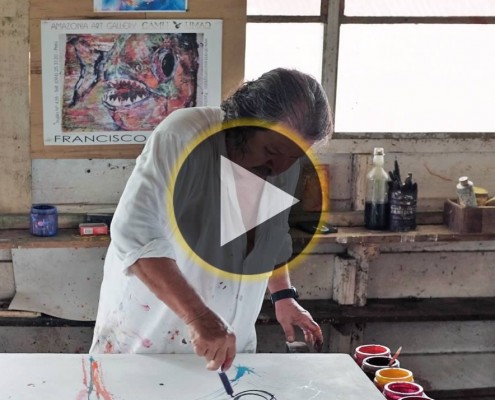
Before we head to the health post though we have to check in with the local Apu (big man). Cesar leads us up a winding path to what could only be described as an Amazonian Castle! The place has a tower and everything! Cesar explains that the monstrosity looming above us belongs to the internationally renowned artist Francisco Grippa—and that he is very cordial with visitors (i.e. he likes to sell them things.) No one seems to be home so Cesar leads us inside one of the dozens of doors into The Gallery. I say “The Gallery” because it’s immediately apparent that The Grippa is a very serious artist. The room we’re now in is the main wing of The Gallery. It’s about 30 feet by 50 feet and has giant canvasses exploding with color… everywhere. The biggest piece is easily 12 feet by 16 feet with the average one being a measly 5′ x 8′ or so. Wild stuff!
While we’re poking around one of the Big Man’s people emerges and lets us know that The Grippa is in town- so off we go.
Down a path, through a gate, some mud and the main square later we find The Grippa relaxing in his bar and restaurant (they call it a Disco, but I never actually saw anyone dancing in the thing so I’m sticking with “bar and restaurant”) working on what does not appear to my carefully trained eye to be his first beer of the afternoon.
Now now now, a bit about The Grippa. And I’m struggling here because I’m not sure how best to describe this unique creature… Well, for starters, The Grippa is a very large man– and he’s always covered with an impressive display of paints, kind of like one of the Jungle Animals he loves so much to capture on canvas. The Grippa will always tell you what he thinks. The Grippa has a larger personality than 99.99% of the people you have—or will ever—meet. The Grippa is crazy. The Grippa Rocks!
[Click the "learn more" button to see the rest of the photos!]
More to come soon-
Mike
How to Conduct an Interview (AidJoy Style!)
Have you ever wondered how the pros interview someone in less-than-ideal situations?
I know I have! :)
I still don’t know- but if you’d like to see how we do it here at AidJoy check out this video:
Interview—AidJoy Style from NGO AidJoy on Vimeo.
Without the support of http://www.foreigntranslations.com and generousindividual donors this work would not be possible.
The People of Lima, Peru
Wednesday, April 6th.
So Jonathan and I finally made it to Peru. We were supposed to fly in this morning but fog coming up the cliffs from the Pacific prevented us from landing in Lima so we were re-routed to a military base where we sat for almost 5 hours listening to some incredibly loud monkey and/or bird sounds playing over a loudspeaker system presumably designed to scare off birds that might decide to Kamikaze the Peruvian Air Force’s jet engines.
We got some good footage while on the plane with Jonathan that shows him explaining AidJoy and Project Amazonas to our neighbor. You guys’ll get to see it down the line.
After running some errands this afternoon in Lima I headed out to take a few snaps. The light was escaping so I only got in about 30 minutes of shooting before it was too dark. The neighborhood we’re in (Miraflores) is a touristy part of town with plenty of shops and a mess of street life. Take a gander at the shots but please keep in mind that they in no way represent Lima, Miraflores (or anything really) as a whole. I was just walking and shooting whoever looked interesting from my hip as I passed.
Anyway- here’s thirty minutes of walking round Miraflores, Lima, Peru. (Be sure to click on the images and let em load up if you want to get a good look at them!)
Enjoy-
:)
And So it Begins (AidJoy’s Trip back to the Amazon)
Atlanta: A 4:30 A.M. alarm clock precedes leisurely bowls of cereal as Jonathan, his girlfriend Karen, and I sit around the floor of Karen’s living room in the dark. There’s no electricity. A stomper of a storm rolled through late last night and shook the place up pretty good. No worries, we have our trusty headlamps! Jonathan and I are scheduled to fly to Miami at 7:20. It’s a leisurely twenty-minute drive to the airport and spirits are high in anticipation of getting down to Peru and getting to work. We’re packed up and out the door before 5:00. Some five blocks through the neighborhood we come to an abrupt halt– there’s a rather large tree blocking the entire road and powerlines lying all over the ground. Hmmmm…. No worries, there’s other routes. Two minutes later we’re turning around again– the trees didn’t fare too well last night.
Now, we’re off with a quickness– the primal fear of a missed flight sitting, unspoken, on our chests. Rounding a bend we’re greeted by the lights of a news crew, another downed tree and more powerlines. Oh Joy! One of the reporters comes up to us and before we can ask him how the devil he got INTO the neighborhood and how WE can get OUT he picks up Karen’s accent when she politely greets him. “You’re French!” he exclaims with a big smile. I can’t tell if he has a thing for French girls or if he just smells a story but Jonathan’s having none of it. “We’re going! We’re going!” says Jonathan, motioning to the reporter to move. The reporter points at Karen and glares at Jonathan “She’s friendlier than you are” then turns away. We dive back into the maze of streets, confronted a few blocks later by yet another tree. OK this is starting to get a bit ridiculous!!!
We turn again, drive two minutes and… guess what? A TREE!!! YAAYYYY WE LOVE TREES!!! Jonathan thinks we have a chance with this one though so out he jumps to move the caution tape. Karen drives through and up to the tree while Jonathan moves branches around. He comes back to the car and directs Karen to drive up the curb and onto the sidewalk, around the tree. No dice- Karen doesn’t like it, so Jonathan jumps in the driver’s seat as I run up to direct him.
There’s a damn stump blocking our path, and the trunk of the tree is still in our way. Jon jumps out and together we manage to pivot the tree in such a way that we MAY have enough room to get through. Jon’s back behind the wheel and ready for action. I hold back some branches and shudder as Jonathan revs the engine, up onto the curb, seemingly trying to jump the stump with Karen’s shiny Civic. The car crunches onto the stump and sits there, stuck. (In case anyone was wondering– Honda Civic’s don’t have very good ground clearance!)
Jonathan’s thankfully able to back the car off the stump and I help him realign for a second try. We’re going to take the front right wheel up onto and over the stump. Some deft maneuvering and inspired driving and *Presto* we’ve beaten the stump. Jonathan’s back out of the car again to help me push the tree (It’s about a fifty-footer) further out of the way, then he jumps back in while I grab branches. Next thing I know Jonathan is flat on his back, groaning. The tree has decided that it’s not going down without a fight! A few tense moments and we determine that Jon’s OK but Karen’s looking a bit flustered. I give her a hug and a smile, reassure her that her car’s alright, and we all jump in.
“Wait a minute- my headlamp!” yells Jonathan. The evil tree has stolen Jonathan’s prized headgear and he isn’t inclined to leave it. After a couple of minutes of rustling through branches with no luck we decide that it’s more important to catch our plane (Who knows how many more trees might be waiting for us) then locate a $35 piece of gear, so off we drive.
Karen appears to be a bit upset and drives silently. Jonathan seems afraid that he may have just squashed Karen’s and his relationship just as it was getting going. I’m glad I’m in the back seat– there’s a bit of tension in the air. After a mercifully incident-free 20 minutes we get to the airport and unload. I’m not sure what Karen is thinking but I’m worried about us leaving her on a bad note. Jonathan’s pretty crazy for Karen and he’s really excited about where their relationship might go. I’m super happy for Jonathan– I just met Karen but I can already tell she’s an awesome person and a great fit for my good buddy.
Thankfully, Karen really is as cool as she seemed to me and a quick phone call confirmed that everything was OK. (As most of you know, Jonathan and I can be pretty intense at times and it’s sometimes difficult for people to understand/cope with the wildness.)
So where does this leave us? At the moment Jonathan and I are in Miami waiting out a good ol fashioned thunder-bumper. We met with Dr. Devon Graham (Project Amazonas’s Executive Director) earlier this morning and hammered out some details for the next few months in Peru. Then we ran some errands and caught up with the lovely Carolina from Colombia for lunch. Tonight we fly to Lima where the journey will continue!!
Thank you for coming along on this ride with us!
Also- a big Thank You to our sponsors: Foreign Translations, Immedion, Watershed Cabins, Eloquia, and Nimlok as well as the individual donors who have supported us. We wouldn’t be here without you guys– but with you, we’re about to make some really positive things happen in the Peruvian Amazon!!
Talk to you soon.
Mike
- Jonathan’s relieved as we arrive at the airport with time to spare.
- Dr. Graham’s taxi service in full swing
- A dumpling at Miami’s Dim Sum restaurant
- Carolina likes Dumplings!
- It’s a stormy day in Miami
- The result of an impromptu modeling session at Starbucks (while writing this post)
Join AidJoy and Project Amazonas in the Amazon Rainforest!
Come! Join us aboard a medical expedition in the Amazon!
There will be two back to back medical expeditions:
May 15th – 21st
May 22nd – 28th
You’re welcome to join us for one week, or both!
There are not many openings for these trips. If you are interested please let me or Dr. Devon Graham know before the boat fills up.
Devon is Project Amazonas’s President & Scientific Director
devon@projectamazonas.org
Availability:
4 non-medical volunteers
2 doctors
2 nurses
1 dentist
1 midwife
BIG PICTURE:
The medical boat will launch from Iquitos Peru; the largest city in the world with no road access. We’ll be traveling through the Amazon jungle aboard the Nenita (Little Baby Girl), a 74-foot river boat constructed of local hardwoods. The Nenita is piloted by a seasoned crew who has been managing medical expeditions in the Amazon for the last sixteen years.
These expeditions have proven to be extremely positive experiences for everyone involved; medical staff, crew, volunteers, and patients alike. Every year Project Amazonas provides health care to some 8,000 rural villagers while giving volunteers the chance to appreciate an exciting culture in the world’s greatest jungle.
WHAT WE’LL SEE:
The Amazon always offers an extraordinary world of exotic wildlife including wooly monkeys, sloths, capybaras, pink dolphins and agoutis, to name a few. However, the real attraction is getting to meet the colorful people who have carved out lives in this remote corner of the world for many generations. On this expedition we will introduce you to the friendly families that live in the village of “flowers”, the village of “hope”, and one of our personal favorites- the “electric eel” village.
OUR WORK:
Isolation, poverty and a general lack of healthcare education or medical supplies available to these communities contribute to an overall poor level of health. Malaria, yellow fever, hepatitis, tuberculosis, bacterial infections, intestinal parasites and snake bites are commonly encountered and treated during medical expeditions. Additionally, Project Amazonas provides training for village health promoters and equips them with the necessary supplies to care for their communities in our absence.
PLAY TIME:
After everyone’s medical needs have been met some people play an impromptu game of soccer, others relax with a cold beer, and personally I love to go swimming with kids in the village.
After sunset we meet-up in the mess hall for dinner. Chef Danilo Amasifuen serves up the finest meals we’ve had anywhere in Peru. We’ll enjoy a meal of fresh fruit and fish provided by local fishermen who attended the day’s medical clinic.
Each evening we’ll lay in our screened-in quarters listening to the sounds of the jungle and wondering what adventures await us tomorrow.
COST:
The cost is $750 a week ($375 for medical students) and covers all expenses while aboard the Nenita. (A good chunk of this money goes to medical supplies and gasoline to get where we’re going– the rest goes to food and other operating expenses.)
NOTES:
A. Neither Spanish nor medical training are necessary though both are helpful.
B. Check out the Medical Civil Action Program (MEDCAP) manual for more info on the region: http://www.aidjoy.org/docs/medcap-manual.pdf
C. If you can’t make it to the Amazon with us not to worry– this is just the first of a series of emails we’ll be sending out over the next couple of months so keep an eye out and we’ll update you as everything unfolds.
AidJoy’s FaceBook Fan Page:
http://www.facebook.com/pages/AidJoy/439077415530?ref=ts
* Without the support of foreigntranslations.com and generous individual donors this work would not be possible.
Huge Hug,
Jonathan, Mike, and Jim